
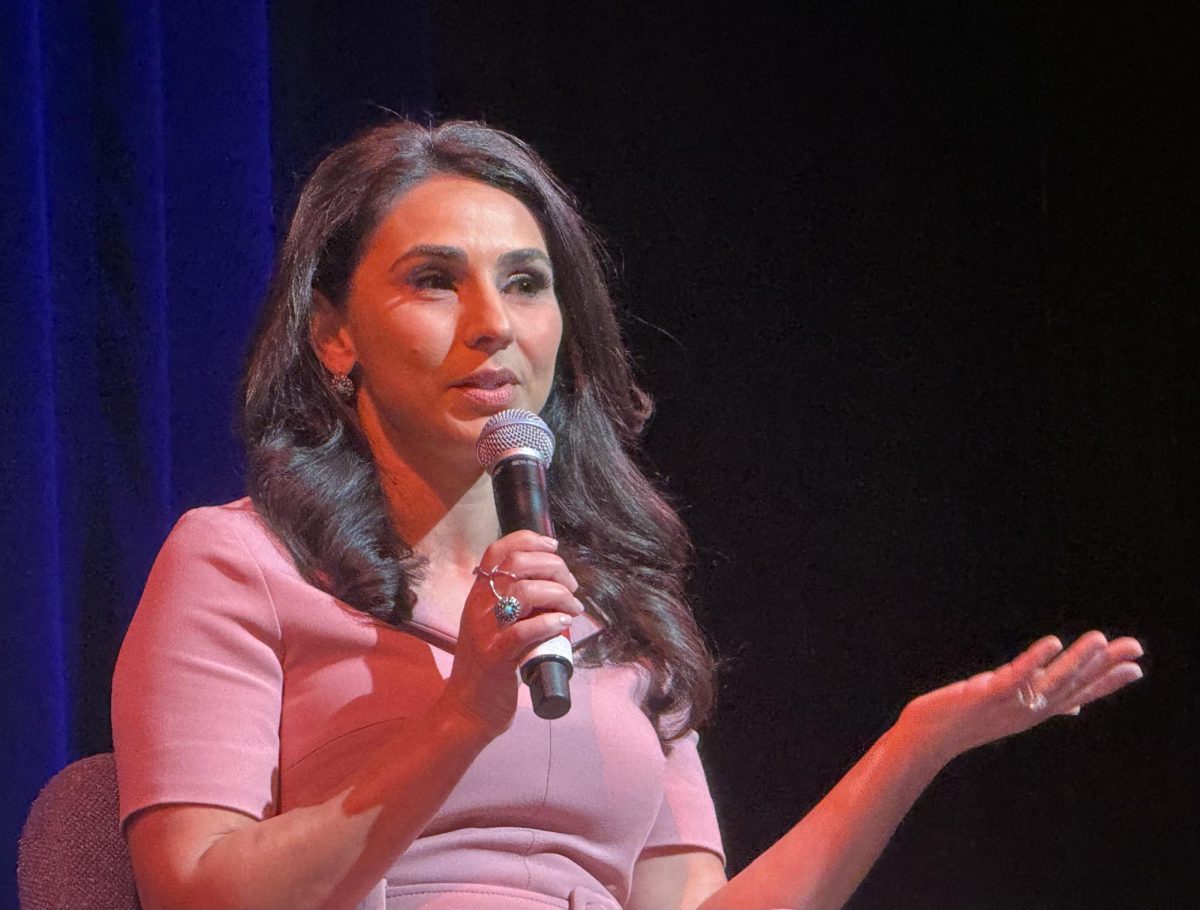
On April 28th the community gathered at the Glendale Community College auditorium to hear news anchor Araskya Karapetyan speak. The foyer of the auditorium was buzzing with energy as attendees convened for some small bites and drinks before everyone took their seats inside.
Karapetyan was interviewed on stage by Vice President of Student Services Alen Andriassian. The interview addressed the beginning of Karapetyan’s career trajectory, the complexities of broadcast journalism, and the preservation of cultural identity in mainstream media.
A central theme of the discussion was Karapetyan’s refusal to compromise her Armenian heritage for professional convenience. She told a story about an incident where a manager of hers suggested she change her name to “Roxy Karpe” to make it more pronounceable. She refused, asserting that her name represented pride in her cultural identity.
During the 2020 Nagorno-Karabakh War, Karapetyan took on the challenge of reporting on a conflict that was deeply personal to her. She reported on human-interest stories from survivors of the war, ensuring that the voice of those affected were not soon forgotten.
Karapetyan emphasized to students that the modern journalism landscape requires a strong sense of adaptability. When asked about how students should approach news reporting as beginners, Karapetyan said to start small wherever you can. “Apply for internships at city-run cable news stations, mine was Torrance,” Karapetyan said.
She noted multitasking as a core skill required for good news reporting. Journalists are conducting interviews or delivering reports as information is being conveyed via IFB earpiece. She spoke about her early career roots in Idaho Falls where she worked as a “one man band.” Karapetyan described herself at the time as a multimedia journalist, where she was responsible for reporting, shooting, editing, and producing her own content.
Another topic Karapetyan spoke earnestly about were the harsh realities of the news reporting industry. She provided a candid look at the psychological toll of being a public figure and dealing with imposter syndrome. “Some of the most insecure people are people on television. You’re always questioning yourself. ‘Did I sound smart enough? ‘Did I research enough?’” Karapetyan said. She also described a “love-hate” relationship with social media, acknowledging that “frivolous” content like makeup and her outfits often drives the engagement necessary to give her “substantive” stories a platform online.
The lecture then turned to an open Q&A to give members of the audience an opportunity to connect with Karapetyan personally. One student, Mia Marerekhashvili, asked how Karapetyan stays focused when speaking publicly as an immigrant whose first language is not English.
“You have to just keep doing it, don’t let it discourage you. I hated public speaking and it did take me about 10 years to get comfortable public speaking. I kept making myself go to events to speak in public to get over that,” Karapetyan said.
Karapetyan also urged students to look beyond on-air roles, noting that news directors and producers often hold the real power to shape narratives and which stories deserve airtime.
It is clear how big a role Karapetyan plays in her community and why she is held at such a high regard by her viewers. Janelle Qamaruzzaman, DSPS counselor at GCC, is to thank for organizing this year’s Language and Communication LPP event and getting Karapetyan to campus to speak to everyone.
Qamaruzzaman is very excited for next year’s event as she plans to integrate the Language and Communications pathway with a DSPS (Disabled Student Programs and Services) focus. While the specific details remain confidential, the overarching theme will continue to be awareness and representation.