
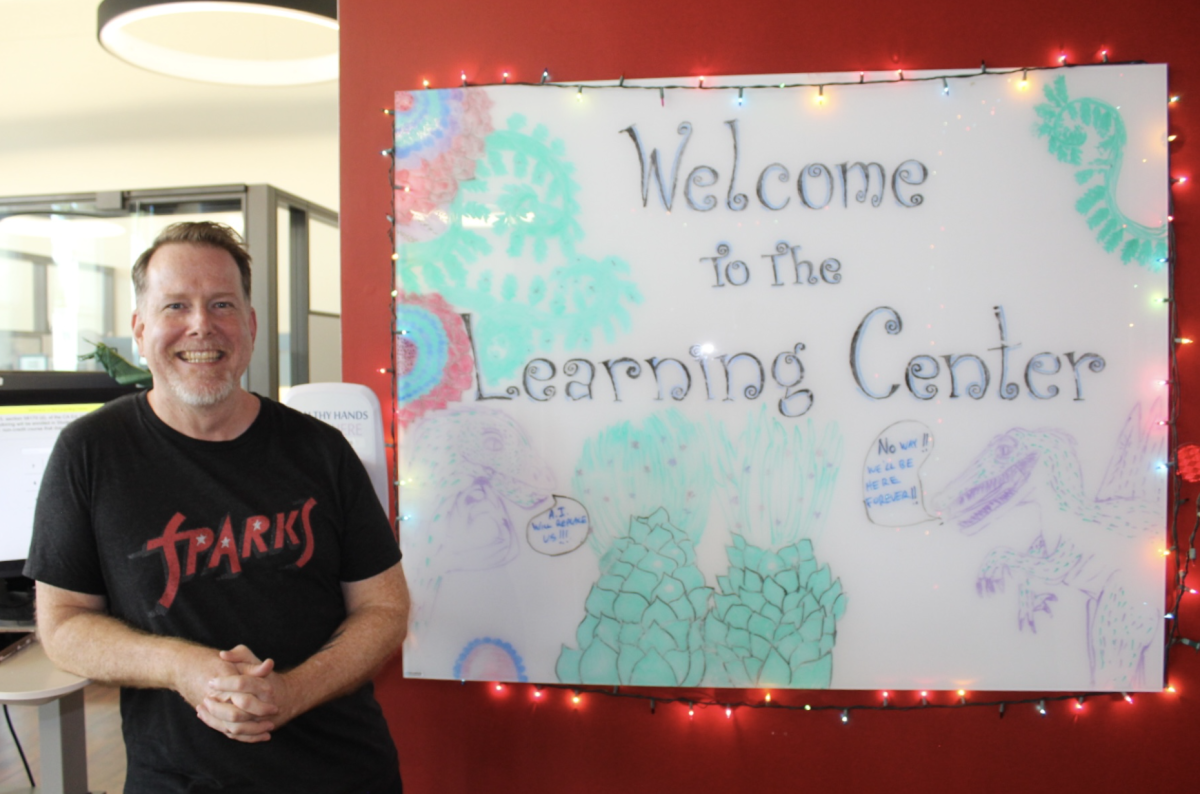
At the heart of the John A. Davitt Administration Building at Glendale Community College, students can find the Learning Center. Located on the second floor, the room is quite hard to miss. Its natural sunlight shines through the center’s large glass windows, filling the wooden interior with an inviting energy.
Whether it’s for academic support, personal development, or general guidance, this environment is designed to meet the needs of all who enter. While many changes have occurred in our post-pandemic world, this free tutoring service has remained a constant support system for students.
Students who first walk in are likely to be greeted by the Learning Center’s Student Services Lab Manager, Andy Stires. “Even though we do a ton of outreach, I still think students just don’t know that we exist,” he said. “We really need to stress that we offer free tutoring.” Serving as a bridge between campus and its attendees, Stires helps to set up appointments, refer students to resources, and more.
Anyone who sits inside for long enough will notice a constant flow of people walking past the doors. Still, while their heads turn in curiosity, many do not take initiative to cross the threshold. A common misconception many assume is that tutoring is run by professors, staff members, or others in an authoritative role. This further discourages them from coming in, creating intense feelings of apprehension. In reality, the space is fully run by student workers who operate on a peer to peer level.
Additionally, connecting with a tutor is fairly easy and offered through many alternatives. Options include in-person sessions, Zoom appointments, and online drop-off submissions for both essays and math problems. Some of these newer modes of support came to a rise once GCC moved their services online due to COVID. While many students find convenience in this, there is a strong flip side involving social and academic changes. “It’s just a completely different world I think, in education now,” Stires said. “Then you throw in AI, and that’s just a whole other can of worms.”
Still, beyond these latest circumstances, the Learning Center has been consistent in its ability to push students toward their academic goals. It’s clear that the normalization of both remote learning and AI has provided users with access to unlimited information at their fingertips. What’s equally important to realize is that AI simply cannot replace things like human connection, a peer’s perspective, and honest feedback. “Learning doesn’t happen in a vacuum,” Stires said. “It’s a team of people doing it, we just want to be one of those stepping stones along the way.”
The true effectiveness this resource has on students relies on the everyday exchanges that lead up to major progress. Writing and Statistics tutor, Edouard Oganesian, touches more on the key methods students can exercise to pave their pathway to success. “Sometimes I see students that come in and they think that one tutoring session is gonna fix everything,” he said. “It is a constant process … consistency is going to get you the best results.” This further shines light on another exchange that AI cannot duplicate, authentic effort that leads to real improvement. Oganesian also hits the nail on the head explaining, “it’s a free resource, it costs you nothing except thirty minutes to an hour of your time a day.”
Though numbers have dropped dramatically, both in tutors and campus life, the Learning Center stands strong for the sake of student needs. Its biggest message emphasizes that anyone is welcome in. You don’t have to be in danger of failing a class nor academically behind before you familiarize yourself with this space. It can be as simple as wanting a change of scenery to study or a homework partner.
A world of scholastic excellence awaits those who take the initiative to use these student-centered services. All that’s left for GCC goers to do is walk through those broad wooden doors, marking the entrance of the center.