
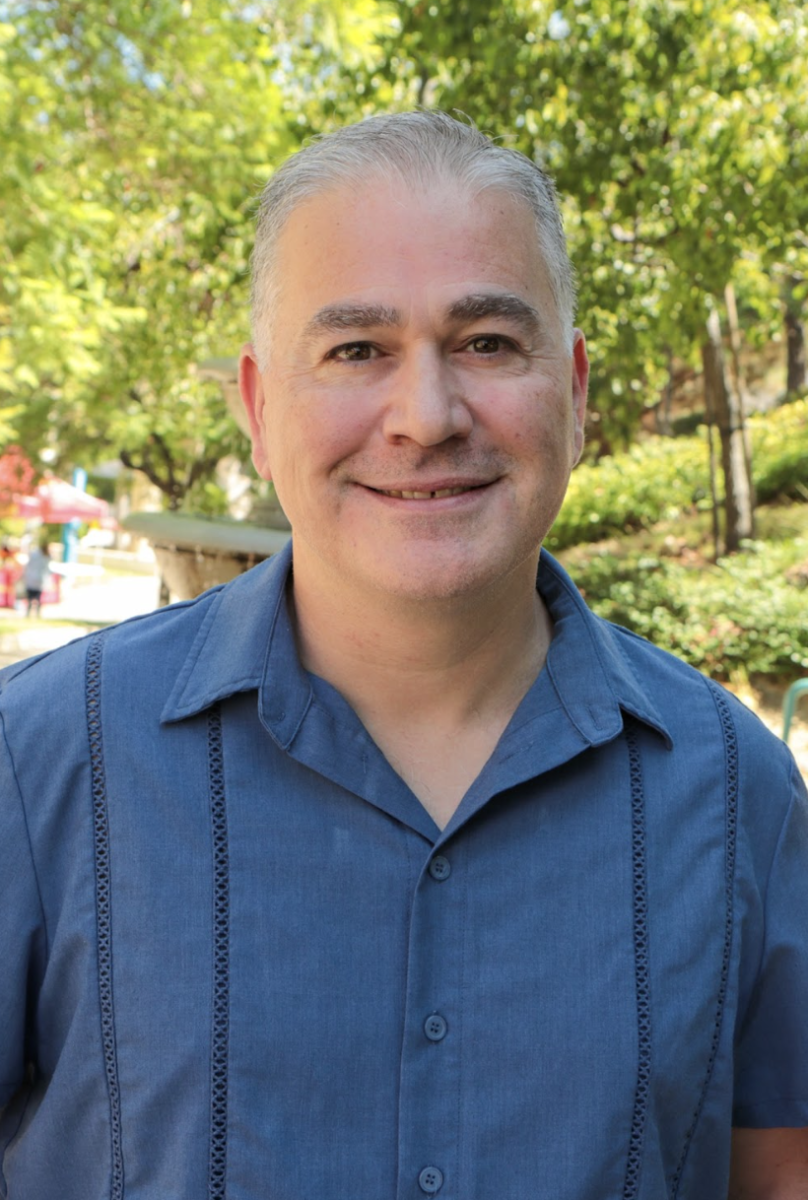
Any student who has been at Glendale Community College long enough understands the vast changes happening in our academic world. Whether it is through the normalization of AI or a fading campus life, it is still important to challenge these changes. On December 10th, faculty member Shant Shahoian sat down to reflect on the many roles he fulfills at GCC. Along with it, diving deeper into educational trends, his teaching philosophy, and what that ultimately means for this new generation.
Of the many hats Shahoian wears, Learning Center Faculty Coordinator, English and Humanities Instructor, and academic Librarian are to name a few. With this, you can imagine how knowledgeable Shahoian is when it comes to campus resources and how it guides students. In comparison to traditional faculty, his role consists of interacting with those from all divisions and other administrators. “I secure grants, I piggyback on other grants, I request funding. I start new programs,” he said. This is especially important to keep free resources standing, like tutoring for students in the Learning Center.
Shifting to his own classroom setting, Shahoian touches on the world he aims to create for his students. Even at a college level, many can feel discouraged without access to creative freedom while learning. By reversing this style, students can actually begin to feel in control of their own education. “I want to create spaces in my classes where students get to make a lot more of their own decisions, kind of like a choose your own adventure novel,” he said. “And be agents in their own education.”
Though labeled as a negative trait among students, Shahoian redefines what it means to feel confused. Especially among young adults, society has wired them to believe that their career choice seals their fate. “My comfort with being fundamentally confused and lost is actually a big benefit,” he said. In reality, taking the time to explore your options only further builds up your confidence within your choices. There is no better place than a community college to do that. “The less you owe, the more options you have,” he said.
To further prove this message, Shahoian recalls his time teaching English 102 at Santa Monica College. He paints the scene of two students sitting next to each other. One was a physicist from Ukraine who spoke decent English. The other was a mother of three who came back to school after 15 years being out. Behind them, was an 18-year-old cheerleader who was fresh out of high school and a student who was in the auto tech program. This exchange truly shows the idea of everyone being on their own academic journey. “You’re just never gonna get that range,” he said.
Fast forward to his time at GCC today, those past moments he witnessed among students may be diminishing. “I saw a rise in online classes … once people get a taste of it, I think they’re gonna want it,” Shahoian said.
In our pre-pandemic world, students often came to class not for an attendance grade, but to showcase their growth. Typically, you take the information you retain and engage in conversations with peers and your instructor. In the moments where you feel stuck, it is part of the process to ask questions and further expand on your knowledge. However, with the growing use of AI, that system has changed dramatically. “I am grieving what education was,” he said. This has ultimately robbed students of those “aha” moments in the classroom.
While the process of getting through college is important, many may be rushing the outcome for the wrong reasons. In conversation, Shahoian reflects on the more ridiculous concept of trading one piece of paper for the next. Students finish college to get a paper as proof of their education. They turn that paper into a company, in exchange for a job that gives you more paper, or money. “It was always college makes you a good thinker and being a good thinker will get you a good job, but then we lost the good thinker part,” he said. Once we take a step back, where is the purpose in that? The true value has always been to go to college because it pushes us to think in unfamiliar ways.
For GCC students in search of support, Shahoian is among the many faculty members who will provide just that. Whether in his office or the library, his warming energy is likely to spark a meaningful conversation.